
Overview
Aptible provides several backup and recovery features for managed databases:- Automatic daily backups
- Manual backups
- Cross-region copy backups
- Final backups for deprovisioned databases
- Point-in-Time Recovery (PITR) for PostgreSQL
How Backups Work
Aptible database backups are volume snapshots of the underlying database storage. Each snapshot is a read-only copy of the database volume captured when the backup is taken. Once a snapshot is created, its contents do not change. You can restore, copy, or purge the snapshot according to the configured policy, but the backup itself remains immutable.Backup Portability
Aptible backups are not SQL dumps or compressed archive files. They are encrypted volume snapshots that rely on Aptible’s database image, configuration, and restore tooling. Because of that design, Aptible-managed backups cannot be directly exported, mounted, or restored outside of Aptible. If you need to move data to another platform or create a portable archive, export the data using database-native tools such aspg_dump, pg_dumpall, mysqldump, or the equivalent tool for your database engine.
Dump and restore PostgreSQL
Dump and restore MySQL
Automatic Backups
By default, Aptible creates an automatic backup of each database every 24 hours. Retention is controlled by the Environment’s backup retention policy. The policy includes these settings:- Daily backups retained: Number of daily backups retained. Default:
30 - Monthly backups retained: Number of monthly backups retained, using the last backup of each month. Default:
12 - Yearly backups retained: Number of yearly backups retained, using the last backup of each year. Default:
6 - Copy backups to another region: Whether Aptible copies backups in the Environment to another region. Default: disabled
- Keep final backup for deprovisioned databases: Whether Aptible keeps a final backup when a database is deprovisioned. Default: enabled
- Point-in-time Recovery for PostgreSQL: Whether PITR retention is enabled for supported PostgreSQL databases. Default: Enabled
- Days of PITR data retained: How many days of PostgreSQL WAL data are retained for PITR. Default:
1
Backup Retention Policy for Automated Backups
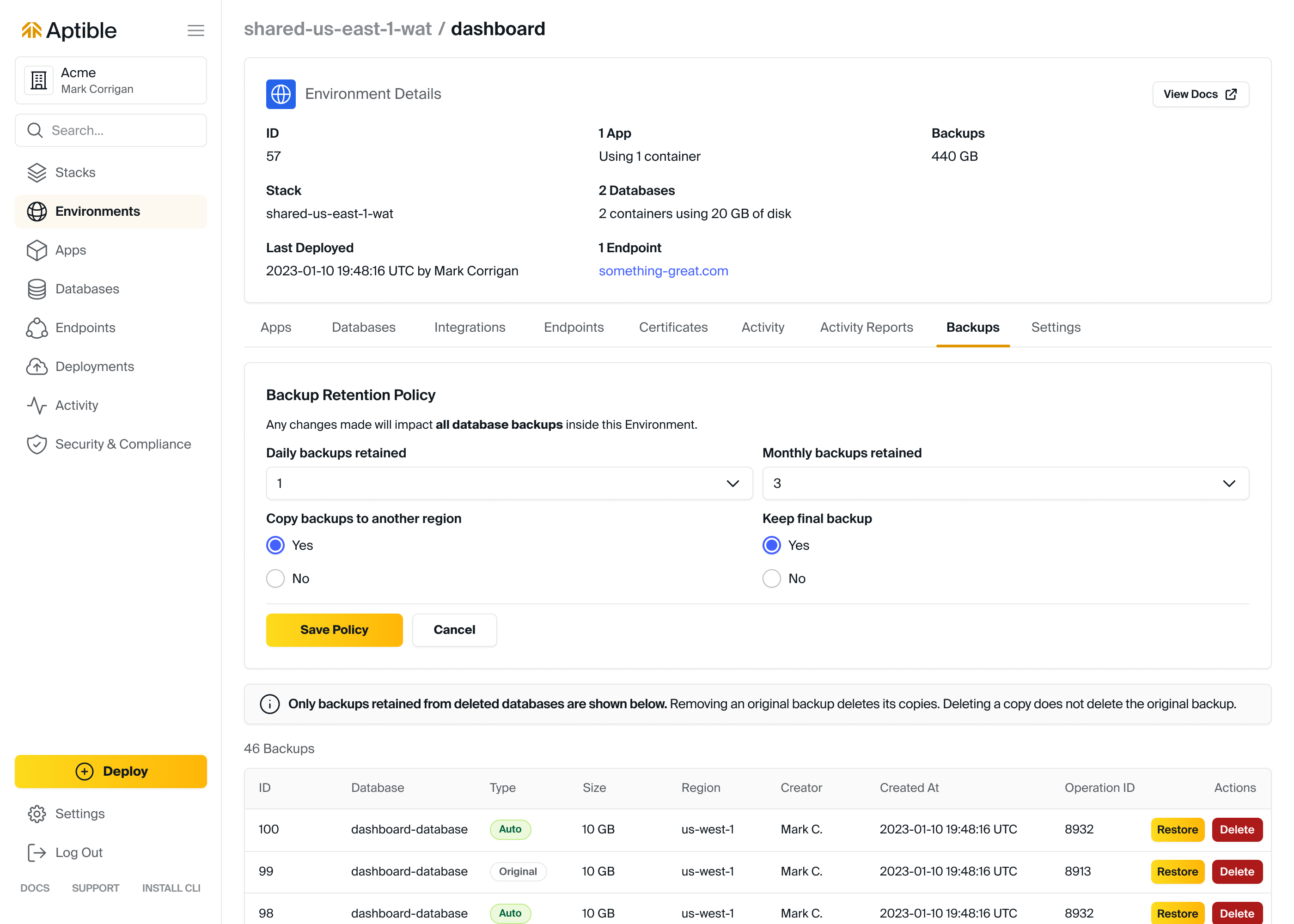
Automatic backup retention and PostgreSQL PITR retention are configured at the Environment level through a shared backup retention policy. You can modify the backup retention policy in these ways:- In the Aptible Dashboard:
- Select the Environment
- Select the Backups tab
- Using the
aptible backup_retention_policy:setCLI command - Using the Aptible Terraform Provider
PITR retention appears in the Dashboard as Point-in-time Recovery for PostgreSQL and Days of PITR data retained. These PITR controls are not self-service configurable today. The current visible values are Enabled and 1. If you need longer retention, contact Aptible Support. For current PITR prerequisites, states, and restore guidance, see Point-in-Time Recovery (PITR).
Retention and Disposal
Cross-region Copy Backups
WhenCOPY BACKUPS TO ANOTHER REGION is enabled, Aptible copies backups in that Environment to a secondary region.
The current cross-region mapping is:
Aptible guarantees that data processing and storage occur only within the US for US Stacks and within the EU for EU Stacks.
Final Backups
WhenKEEP FINAL BACKUP is enabled, Aptible creates and retains one final backup when a database is deprovisioned. Final backups remain available as long as the Environment continues to retain them under policy.
Excluding a Database from New Automatic Backups
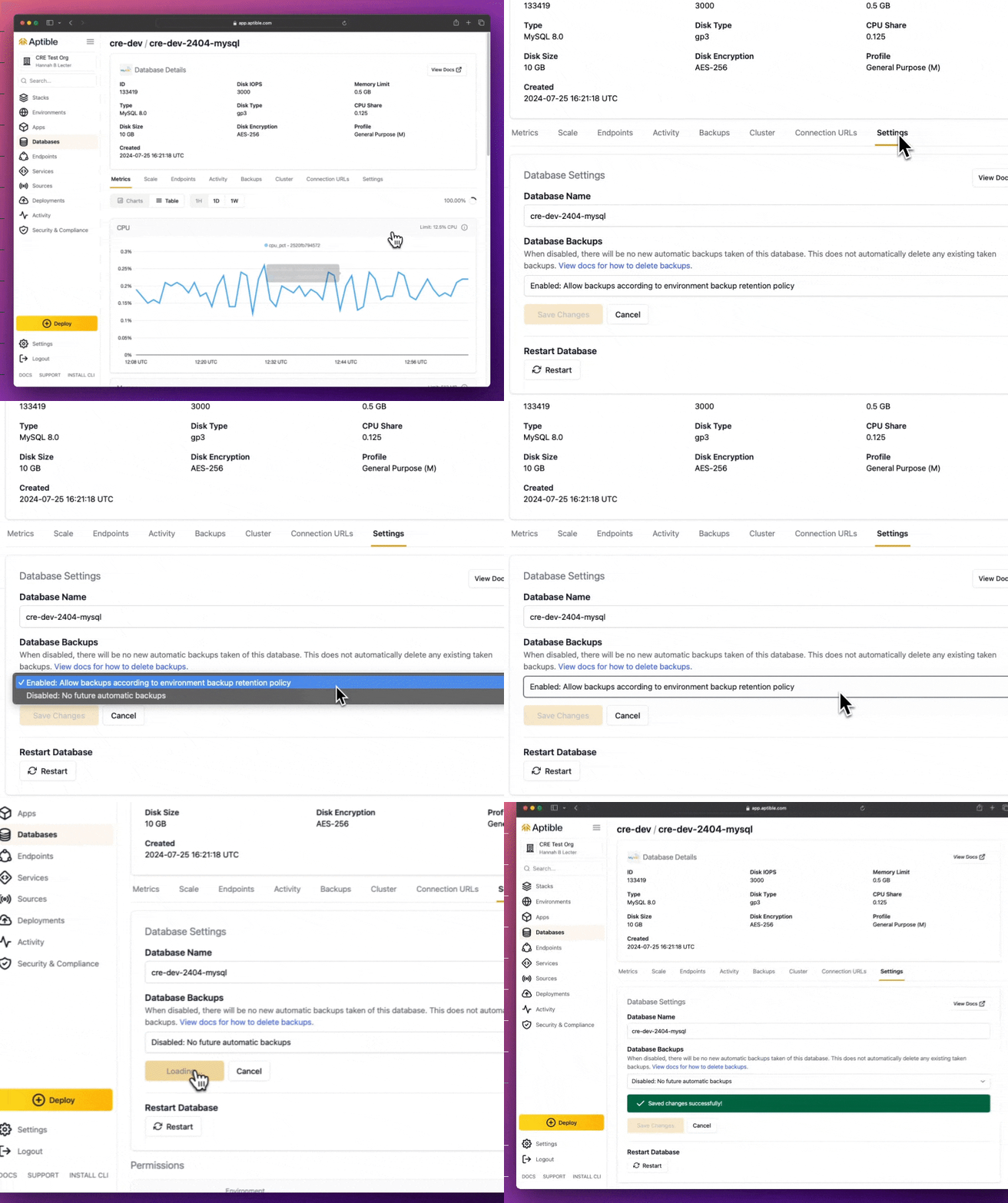
- Aptible stops taking new automatic backups for that database
- Aptible does not create a final backup during deprovisioning, even if the Environment policy normally retains final backups
- Existing backups are not deleted automatically
- Use
aptible backup:list DB_HANDLEto identify backups - Use
aptible backup:purge BACKUP_IDto delete them - Or export output as JSON:
Manual Backups
Manual backups can be created at any time and are retained until you explicitly delete them, even after the source database is deprovisioned.Purging Backups
Automatic backups are permanently deleted when the associated database is deprovisioned unless retained as final backups. Final backups and cross-region copies that no longer match policy are also purged automatically. This cleanup process can take up to 1 hour. You can also manually delete individual backups.Restoring from a Backup
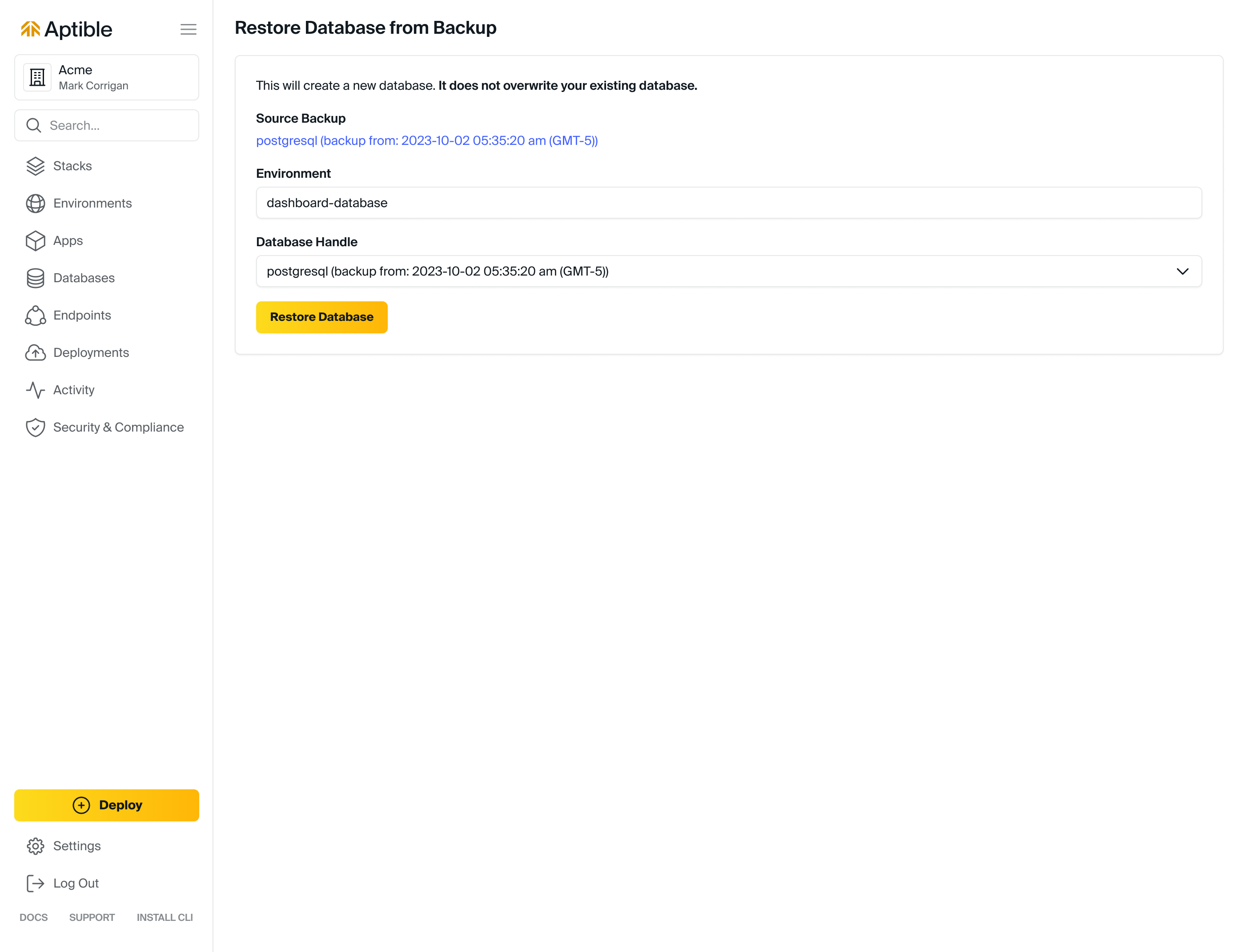
Restoring from a backup creates a new database from the backed-up data. It does not replace or modify the source database. By default, restored databases are created as a 1 GB General Purpose (M) Container Profile, though you can specify container size and profile withaptible backup:restore.
Databases backups are stored as EBS snapshots. Databases restored from a backup can initially have degraded disk performance, as described in AWS’s “Restoring from an Amazon EBS snapshot” documentation. If you are using a restored database for performance testing, run the test twice: once to warm the restored volume, and a second time to measure steady-state performance. Restoring in the same region as the original backup generally minimizes initialization time.
Point-in-Time Recovery for PostgreSQL
Point-in-Time Recovery (PITR) is a feature available specifically for Aptible Managed PostgreSQL databases, allowing recovery to specific points in time, independent of automated, scheduled backups. Visit the dedicated Point-in-Time Recovery (PITR) page to learn how to make the most of this feature.Encryption
Aptible’s built-in Database Encryption applies automatically to backups of a given database.FAQ
How do I modify an Environment's backup retention policy?
How do I modify an Environment's backup retention policy?
Backup retention policies can be modified in one of these ways:
-
Within the Aptible Dashboard:
- Select the Environment
- Select the Backups tab
-
Using the
aptible backup_retention_policy:setCLI command -
Using the Aptible Terraform Provider
How do I view or manage automatic backups?
How do I view or manage automatic backups?
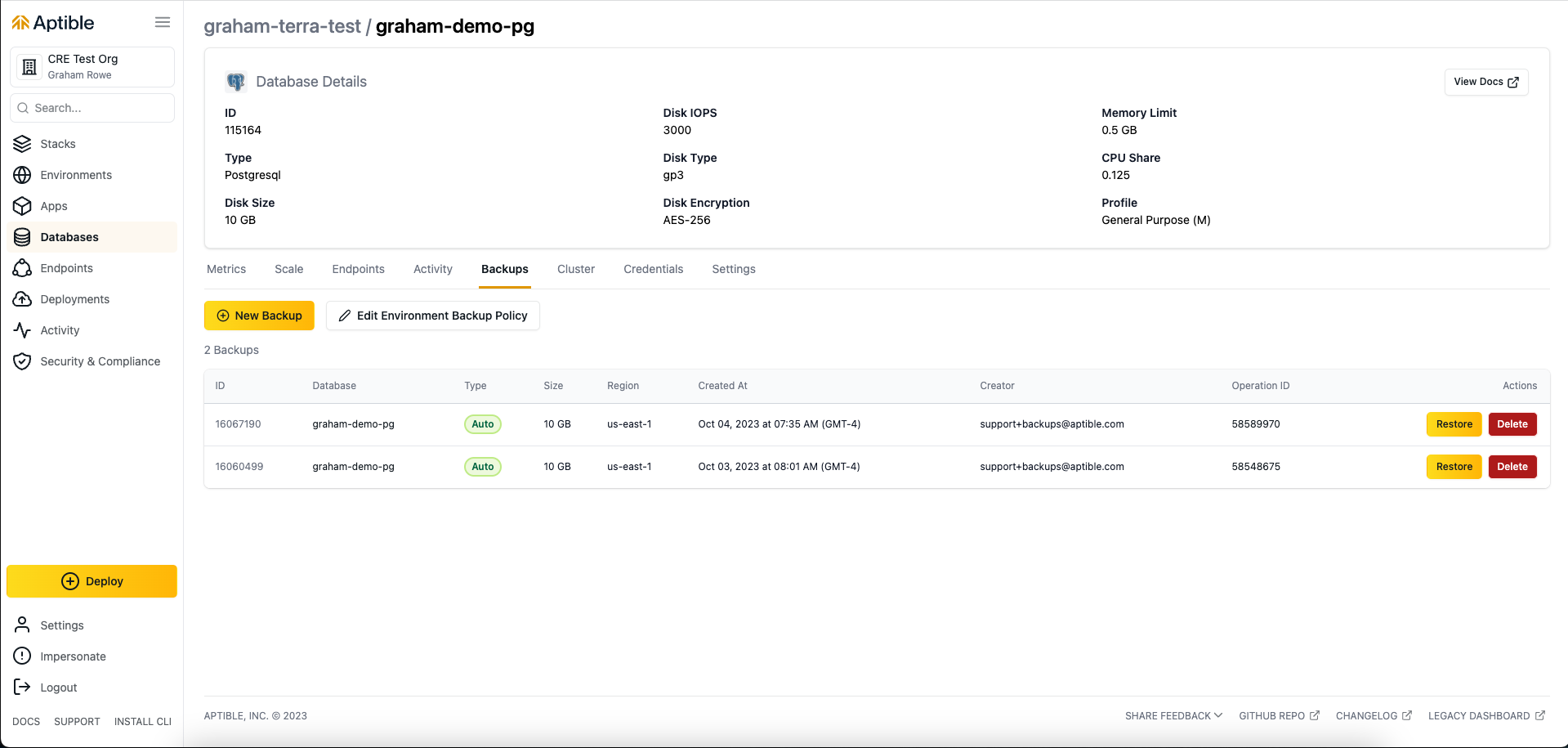
You can view automatic backups in two ways:
- Using the
aptible backup:listcommand - Within the Aptible Dashboard by navigating to the database’s Backups tab
How do I view or manage final backups?
How do I view or manage final backups?
Final backups can be viewed in two ways:
- Using the
aptible backup:orphanedcommand - Within the Aptible Dashboard by navigating to the Environment’s Backup Management tab and selecting Retained Backups of Deleted Databases
How do I create manual backups?
How do I create manual backups?
Manual backups can be created in two ways:
- Using the
aptible db:backupcommand - Within the Aptible Dashboard by navigating to the database’s Backup Management tab and selecting Create Backup
How do I delete a backup?
How do I delete a backup?
Backups can be deleted in these ways:
- Using the
aptible backup:purgecommand - For active databases, in the Aptible Dashboard:
- Navigate to the Environment
- Select the database
- Select the Backups tab
- Select Permanently remove this backup for the backup you want to delete
- For deprovisioned databases, in the Aptible Dashboard:
- Navigate to the Environment
- Select the Backup Management tab
-
Select Delete for the backup you want to remove
How can I exclude a database from automatic backups?
How can I exclude a database from automatic backups?
- Navigate to the database
- Select the Settings tab
- Choose Disabled: No new backups allowed within Database Backups
How should I set my backup retention policy for production environments?
How should I set my backup retention policy for production environments?
A typical production policy might look like this:
- Yearly backups retained: 0-6
- Monthly backups retained: 3-12
- Daily backups retained: 15-60
How should I set my backup retention policy for non-production environments?
How should I set my backup retention policy for non-production environments?
A typical non-production policy might look like this:
- Yearly backups retained: 0
- Monthly backups retained: 0-1
- Daily backups retained: 1-7
How do I restore a backup?
How do I restore a backup?
You can restore a backup in these ways:
- Using the
aptible backup:restorecommand - For active databases, within the Aptible Dashboard:
- Navigate to the Environment
- Select the database
- Select the Backups tab
- Select Restore to a New Database from the backup you want to restore
- For deprovisioned databases, within the Aptible Dashboard:
- Navigate to the Environment
- Select the Backup Management tab
-
Select Restore to a New Database for the backup you want to restore