

Overview
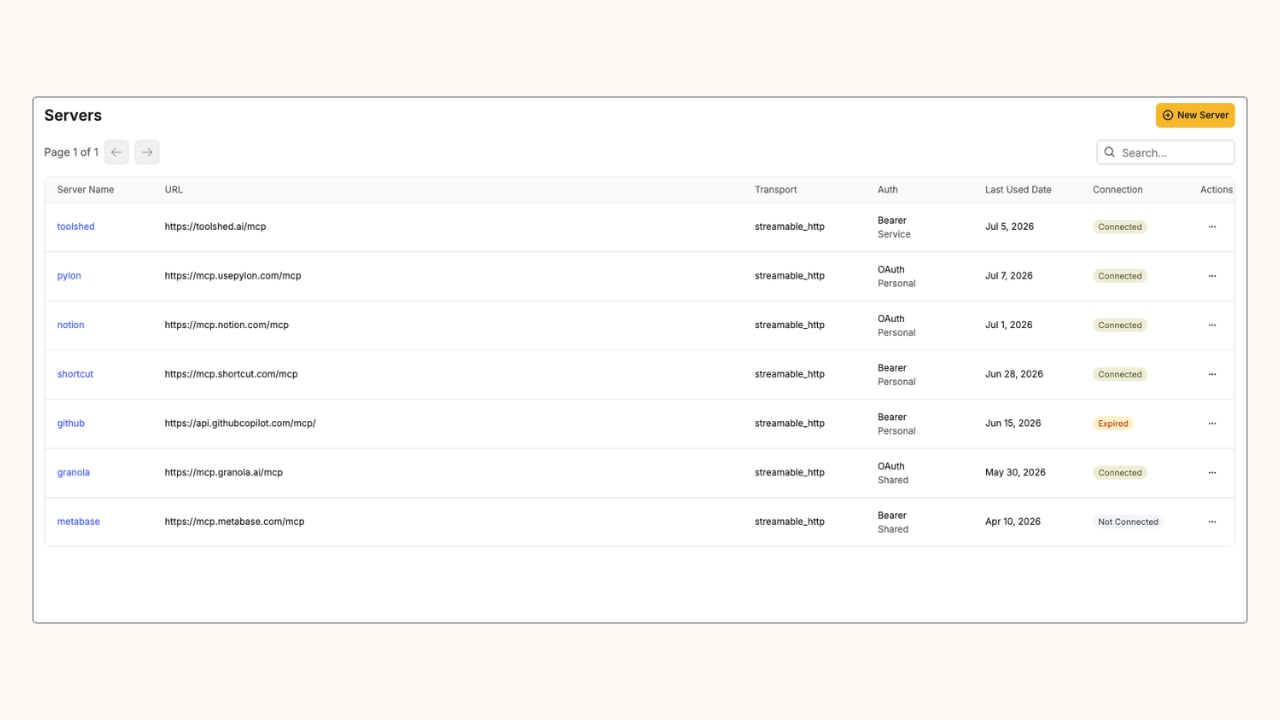
- Servers are the upstream MCP services registered with the gateway: GitHub, Notion, an internal API, or any service that speaks MCP. A server holds credentials, exposes a URL, and defines what capabilities are available.
- Tools are the individual functions a server exposes:
list_repos,create_issue,search_documents, and so on. Tools are what agents actually call. Connect a server and its tools are discovered and kept in sync automatically.
Account Owner or Admin permission is required to manage and modify servers and tools.
Connecting a Server
Register a new server (Admins only)
Register a new server (Admins only)
1
Open the Servers tab
In the MCP Management Console, navigate to the Servers tab and click New Server.
2
Name the server
Enter a name for the server. Names must start with a letter and contain only lowercase letters, digits, hyphens, and underscores (e.g.
github, internal-api). The name becomes the namespace prefix for all tools on this server. A server named github with a tool called list_repos becomes github_list_repos.3
Enter the server URL
Enter the endpoint your upstream MCP server is running on.
4
Select the transport type
Most servers use Streamable HTTP. Select SSE if your server requires it.
5
Configure server authentication
Choose the credential mode (shared or personal) and the auth type that matches how your upstream server expects to be authenticated. See Server Authentication below.Click Save. Aptible connects to the server and discovers its available tools.
Server Authentication
Server authentication controls how the gateway talks to your upstream MCP server, separate from how end users authenticate to the gateway (see Membership for that). It comes down to two choices: who the credentials belong to, and how they’re presented to the upstream server.Credential Mode
Shared-mode credentials are configured by account owners and admins only. Personal-mode servers show a Connect button for users who haven’t yet connected, and a Reconnect button when re-authorization is needed. The Auth column on the Servers list shows both the credential mode and auth type (e.g.
oauth / personal, bearer / shared).
Auth Type
For OAuth servers, clicking Save (or Connect in personal mode) redirects you to the upstream service to complete authorization. Aptible performs Dynamic Client Registration automatically if the server supports it.
Tool Discovery
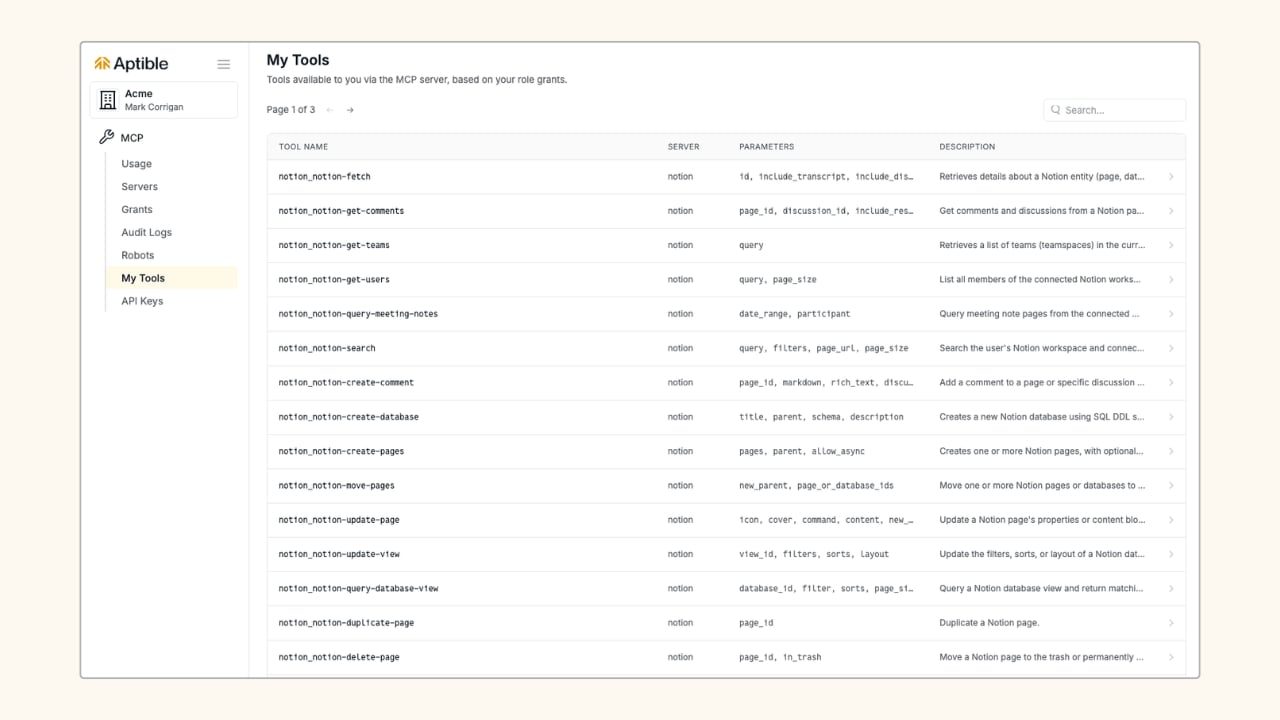
After a server is saved and authorized, Aptible fetches its list of available tools. Each tool is namespaced under the server name:github_list_repos, notion_search, etc. The Tools column on the Servers list shows the count of discovered tools.
Tool definitions refresh automatically. If a server shows Re-authorize, the gateway’s credentials need to be renewed before tool calls will succeed.
View Your Tools
Next Steps
Connecting a server makes its tools available in the gateway but doesn’t grant anyone access to them.Grants
Scope which tools each user or agent can call.
Membership
Set up robots and API keys for automated pipelines.