Where fintech teams get burned
Once you’re storing financial data, security and auditability become part of your product
Fintech teams tend to ship quickly in the early days. Then a bank partner, enterprise customer, or auditor asks you to explain how your infrastructure actually works. Suddenly early architecture decisions become security liabilities.
Security reviews expose infrastructure shortcuts
Partners ask how production access is controlled, how infrastructure changes are tracked, and how environments are isolated.
SOC 2 preparation forces infrastructure cleanup
Audit preparation often reveals gaps teams postponed earlier. Logging coverage is inconsistent and access controls are broader than intended. Instead of documenting safeguards, teams end up rebuilding parts of their stack.
Bank and partner diligence slows integrations
Sponsor banks, payment processors, and financial institutions perform deep security reviews before approving integrations. Many require evidence that your infrastructure meets PCI DSS standards at the service provider level, even if you're not storing card data directly.
Infrastructure complexity grows faster than governance
Payments, ledgers, fraud detection, analytics, and dashboards all introduce new services and access paths. Over time it becomes harder to understand who can access production systems and where financial data flows.
AI tools introduce new financial data risks
Fintech teams are rapidly experimenting with AI for fraud detection, transaction analysis, and support automation. Without clear guardrails, sensitive financial data can end up flowing through systems that were never designed for regulated workloads.

Launch payments and transaction systems
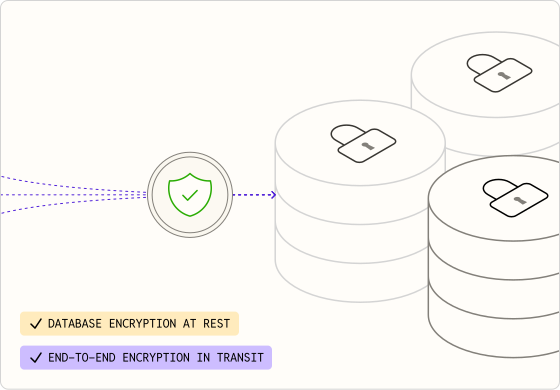
Run payment services, transaction processors, and customer APIs with encryption, isolation, access logging, and infrastructure guardrails enforced by default.
Pass partner security reviews
Answer diligence questions about infrastructure isolation, encryption, access controls, and operational history without reconstructing your architecture.
Operate ledgers and financial data systems
Run databases and ledger services with clear access boundaries and infrastructure activity history that holds up during PCI DSS assessments, SOC 2 audits, and partner security reviews.
Use AI safely with financial data
Route AI requests through controlled infrastructure with logging, credential management, and guardrails around how financial data interacts with models.
SOC 2 Type II and infrastructure controls
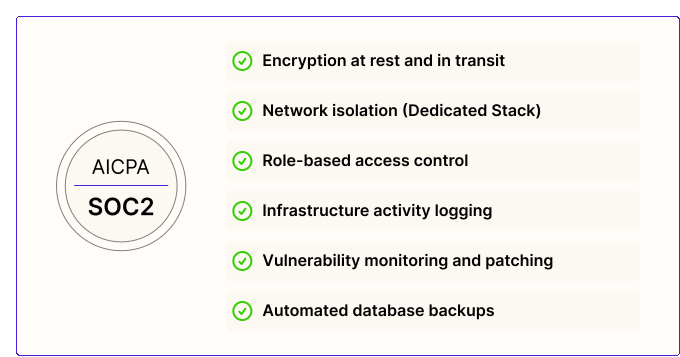
Most fintech startups pursue SOC 2 Type II at some point as they begin selling to enterprises and financial institutions. Many SOC 2 technical requirements relate directly to infrastructure behavior.
When deploying on AWS, teams must design and maintain these safeguards themselves. With Aptible, many of these controls are already enforced at the platform layer, reducing the engineering work required to implement and demonstrate them during audits.
Achieving soc 2 on aptible
PCI DSS and infrastructure compliance for fintech
As fintech companies build payment infrastructure, pursue PayFac models, or integrate with sponsor banks, PCI DSS becomes a real requirement. Achieving it means demonstrating that your infrastructure meets a defined set of technical controls.
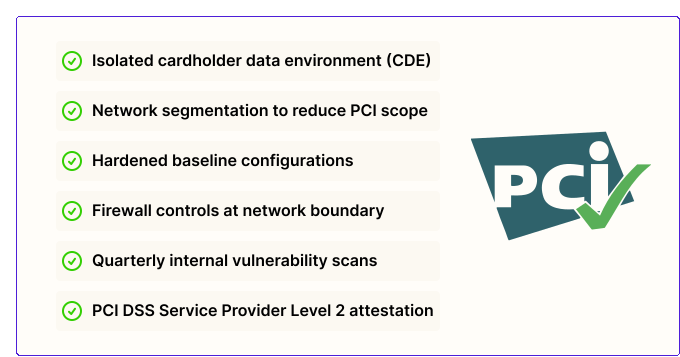
Aptible holds a PCI DSS Service Provider Level 2 attestation. When you deploy on a Dedicated Stack, Aptible enforces the infrastructure-layer controls required for PCI DSS compliance. The hardest part of your assessment is already handled: proving that the underlying platform is secure.
You still own your application layer. But instead of building PCI-compliant infrastructure from scratch on AWS, you inherit it.
achieving pci dss on aptible