

Ship healthcare software without the compliance drag

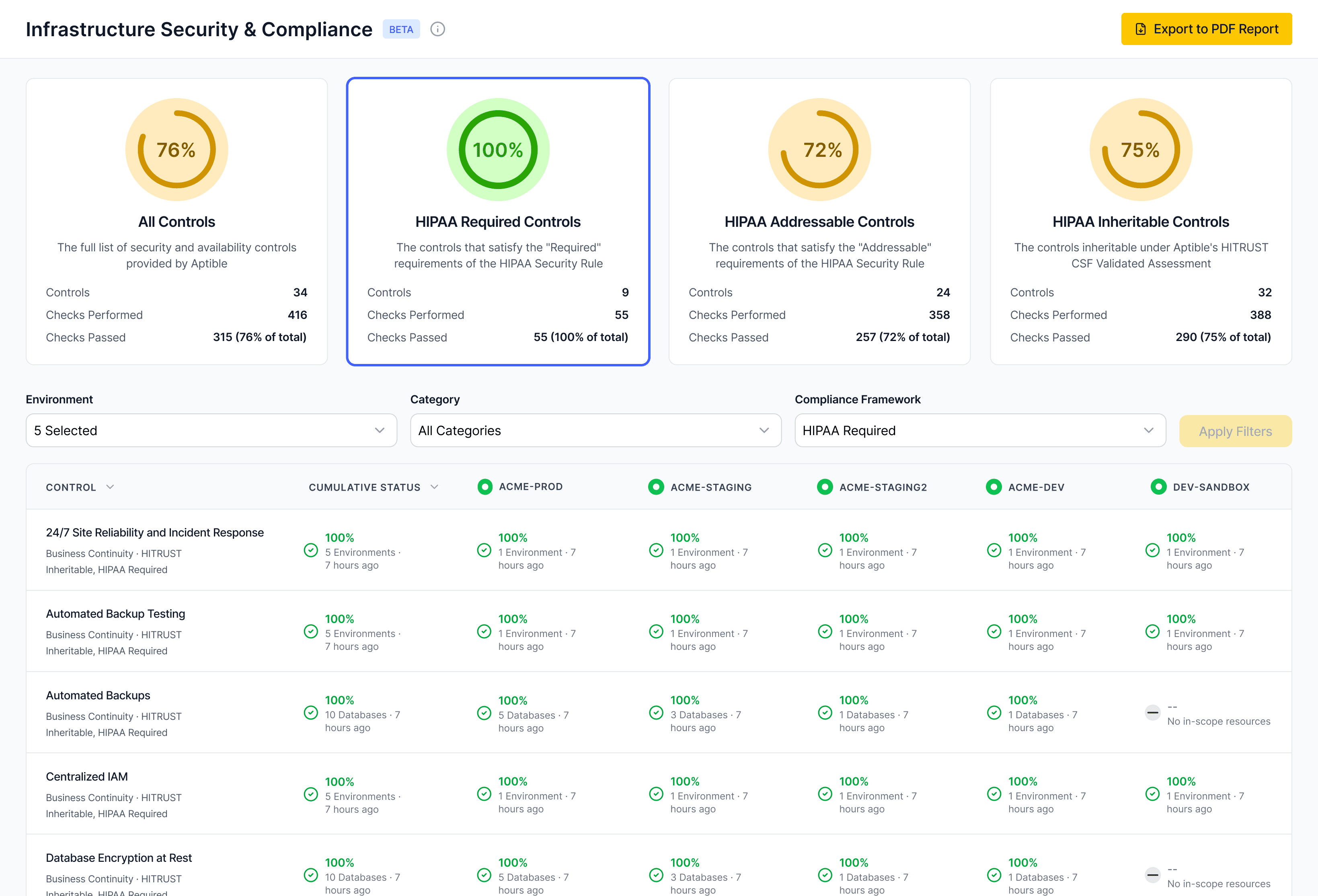
Digital health teams use Aptible to deploy PHI workloads with 100% of HIPAA infrastructure controls enforced by default

Ship healthcare software without the compliance drag

Digital health teams use Aptible to deploy PHI workloads with 100% of HIPAA infrastructure controls enforced by default

"Our team can have confidence that if you're building inside of Aptible, all those HIPAA boxes are checked. You don't have to confirm anything when deploying inside of Aptible. That's a huge win."

Read Case Study

What goes wrong in digital health

The moment PHI enters your system, you’re operating under HIPAA

Early infrastructure decisions become compliance liabilities, causing teams to spend months on rework. These are the five failure modes we see most frequently.

PHI shows up where it shouldn’t

Logs and analytics become the leak. A “helpful” debug line captures patient name + DOB, a failed webhook payload lands in an error tracker, or an analytics event includes a diagnosis code. Now your telemetry is regulated data.

PHI shows up where it shouldn’t

Logs and analytics become the leak. A “helpful” debug line captures patient name + DOB, a failed webhook payload lands in an error tracker, or an analytics event includes a diagnosis code. Now your telemetry is regulated data.

Non-prod becomes in-scope

Staging turns into production. A support escalation needs “a real example,” so someone copies a production row into staging. A demo environment quietly keeps real patient data because “we’ll delete it later.” It rarely gets deleted.

Access expands and never retracts

“Temporary admin” becomes permanent. A contractor gets broad access for a migration. A break-glass key gets shared in Slack during an incident. A CI token that can read everything stays alive long after the fire is out.

Documentation drifts from reality

Docs say one thing, infra does another. The security policy says “least privilege,” but IAM roles are wide because tightening them breaks deploys. The runbook says “logs retained,” but retention depends on a tool nobody owns.

Customer security reviews force archaeology

You’re asked to prove, not promise. Buyers ask: “Show me who accessed production,” “How long are logs retained,” “What changed last week,” “Where does PHI go,” “What’s your incident process.” Deals stall or fail because teams can’t produce complete, attributable evidence on demand.

Why things break in digital health

Infrastructure tools weren’t designed for digital health teams

Why things break in digital health

Infrastructure tools weren’t designed for digital health teams

DIY cloud spreads controls across everything

Audit logging, retention, encryption, and network rules each live in different places, owned by different people, and break differently when architecture changes.

DIY cloud spreads controls across everything

Audit logging, retention, encryption, and network rules each live in different places, owned by different people, and break differently when architecture changes.

Generic PaaS optimizes for speed, not audit readiness

You can ship fast with Heroku and Render, but when a customer asks you to prove isolation or explain your retention policies, you may struggle to show the underlying behavior.

Generic PaaS optimizes for speed, not audit readiness

You can ship fast with Heroku and Render, but when a customer asks you to prove isolation or explain your retention policies, you may struggle to show the underlying behavior.

Compliance tooling tracks tasks, not behavior

Checklists don’t enforce controls. You can mark a control as “done,” but environments still drift, permissions widen, and retention settings expire.

Compliance tooling tracks tasks, not behavior

Checklists don’t enforce controls. You can mark a control as “done,” but environments still drift, permissions widen, and retention settings expire.

Use Cases

How digital health teams use Aptible

Use Cases

How digital health teams use Aptible

Deploy PHI workloads

Run apps, databases, and AI with encryption, isolation, access logging, and least-privilege IAM enforced by default.

Add services safely

Introduce new apps, workers, databases, or AI endpoints without redefining network boundaries, rewriting IAM, or rebuilding your logging model.

Produce audit artifacts

Export access history, change events, backup posture, and retention settings directly from the platform.

Pass security reviews

Answer diligence questions about PHI flow, isolation, access, and incident response without re-architecting your stack.

aptible vs aws diy

What compliant deployment actually requires in digital health

The difference between deploying directly on AWS and deploying with compliant infrastructure on top of AWS is who owns the guardrails around PHI.

Deploying directly on aws

Hardened infrastructure maintained for you

Harden and maintain the base OS

Least-privilege access model built in

Design and maintain IAM roles that reflect real operational access

Network isolation enforced by default

Design VPC botundaries and enforce environment isolation

Encryption configured automatically

Configure TLS and encryption for databases and backups

Centralized, reviewable activity logging built in

Set up CloudTrail and verify audit coverage

Logging and retention aligned with compliance requirements

Define log retention and prevent PHI from leaking into telemetry

Encrypted backups with defined retention built in

Design and test backup and restore strategy

Continuous monitoring and scanning included

Implement vulnerability scanning and monitoring

Keep shipping. Safety happens automatically.

Deploy in minutes.

Keep shipping. Safety happens automatically.

Deploy in minutes.